

Taesung Kimchi has established a HACCP system and is doing its best to supply safe kimchi by securing food safety by installing a washing plant and a metal detection process as important management processes to supply safe and hygienic kimchi.
To prevent contamination by microorganisms such as food poisoning, you must go through the hygiene room before entering each workroom. In the hygiene room, boot sterilizers, hand sterilizers, boot washers, air showers, hand washers, and dust removers are installed to block the inflow of microorganisms and dust into the workplace.
In addition, by using the laboratory, experts who have completed microbial testing training according to the manual of the HACCP system conducted microbial testing for each raw and subsidiary material, process, and finished product, further improving product safety.
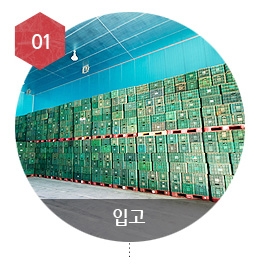
This cabbage is hard and full (summer - cabbage from the highland region of Gangwon-do, winter - cabbage from the Haenam region of Jeolla-do), and the vegetable filling and seasoning are made with the highest quality raw materials, boasting the highest quality.
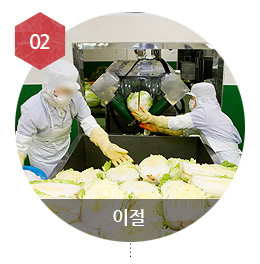
Cut the cabbage into 2 pieces.
(Hygienic clothing is worn during all processes to prevent foreign substances and contamination)
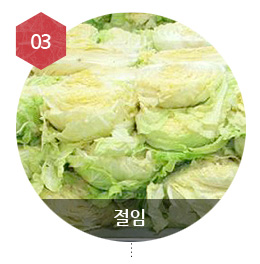
Soak in salt water and marinate for more than 12 hours.
(The salt water salinity, brine temperature, and pickling time are regulated, so the pickling condition is maintained almost unchanged.)
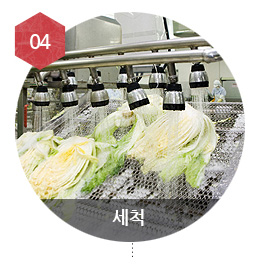
Foreign matter and other contaminants are thoroughly washed away through automatic two-stage cleaning.
(As an important management process, each process is monitored and records are maintained)
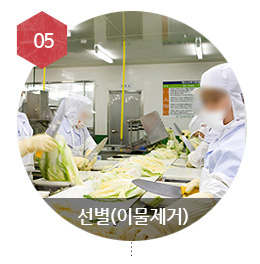
As a process between the cleaning process (automatic two-stage cleaning and semi-automatic cleaning), several workers check again for any remaining foreign substances and contaminants that may be present after automatic cleaning.
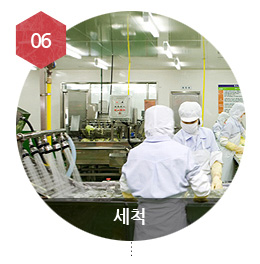
Through automatic two-stage washing and sorting, the cleanly pickled cabbage is washed once again to minimize the residual rate of foreign substances and contaminants.
(After washing, before putting it in the dehydration box, inspect each cabbage leaf according to the important management process manual to check for any remaining foreign matter)
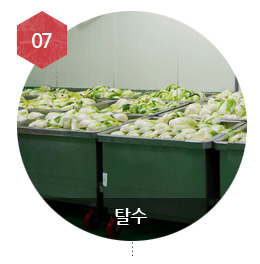
Dehydrate the washed semi-finished product for more than 12 hours.
(Because the dehydration process is performed in a refrigerator, it prevents contamination from falling objects and the growth of microorganisms.)
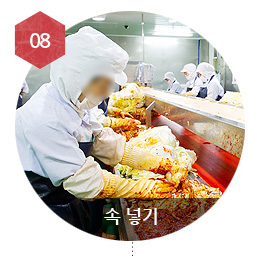
In the seasoning room, we carefully mix the seasonings made according to measurements and regional characteristics in a safe, clean and careful manner with the mindset of making kimchi for our family to eat.
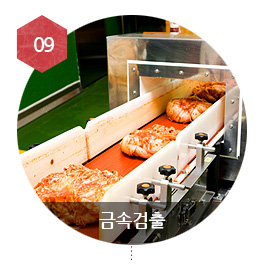
Immediately before packaging, the product is inspected again for foreign substances using a metal detector.
(As an important management process, each process is monitored and records are maintained)
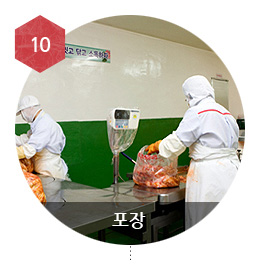
It is carefully packaged by professionals with many years of know-how.
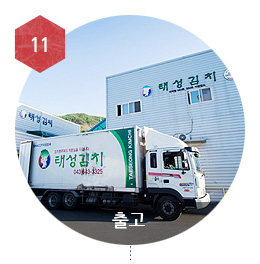
Finished products that have been refrigerated (below 5°C) are safely delivered to dealers across the country.
(Refrigerated vehicles: maintained below 10°C)